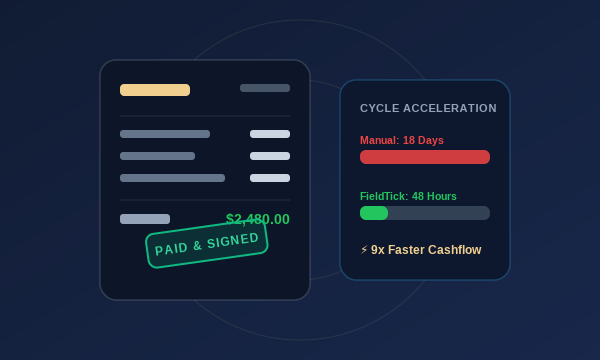
Paper job sheets and clipboard forms appear cheap because there is no immediate software subscription line item. But when finance leaders calculate the downstream cost of re-keying lost records, unbilled emergency parts, and multi-week billing lag, paper is often the most expensive technology a company can run.
The 18-day billing lag
Consider the typical paper lifecycle: a service engineer completes a repair on Tuesday. The paper job sheet sits on the van's passenger seat until Friday. On Monday, administrative staff manually re-enter handwritten notes into ERP software. If a part number is smudged, emails bounce back and forth. By the time an invoice reaches the customer, 18 to 24 days have passed.
"Paper looks cheap until you count lost forms, delayed billing cycles, and unbilled extra parts. Digitizing work orders means sign-off and invoicing happen on site."
Instant digital sign-off and on-site invoicing
With FieldTick mobile work orders, every diagnostic check, replaced part, and photo proof is captured in real time. The customer reviews the completed scope and signs directly on the technician's glass screen. The invoice or job sheet is generated immediately and synced to Salesforce or ERP within seconds.